
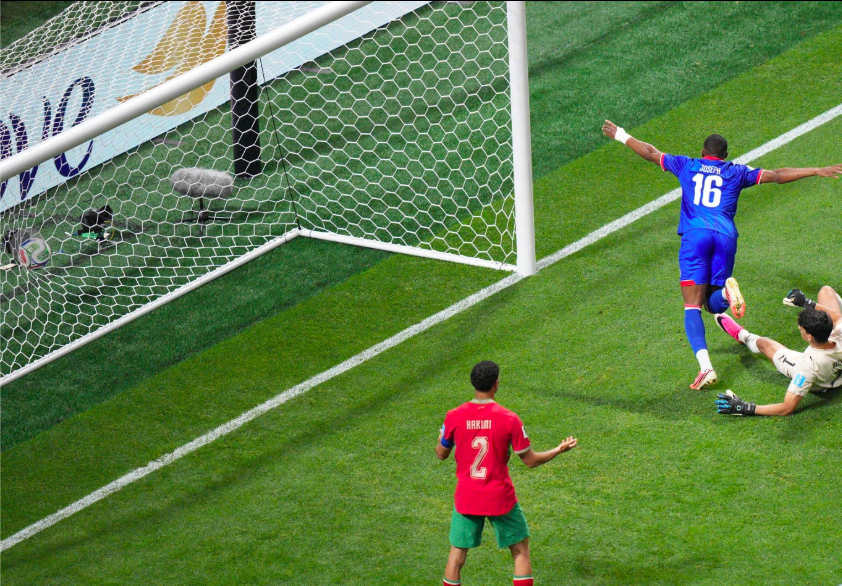
A 52-Year Wait, Broken in 33 Minutes
To understand why this moment matters, you have to go back to June 15, 1974, in Munich, West Germany. Haiti — the first majority-Black nation ever to qualify for a FIFA World Cup — walked onto the field against an Italian team many considered unbeatable. Italy’s goalkeeper, the legendary Dino Zoff, hadn’t conceded a goal in 1,142 minutes of international play.
Then a 22-year-old amateur striker named Emmanuel “Manno” Sanon, who played for a small club called Don Bosco, dribbled past a defender and sent the ball past Zoff. The stadium went silent. Haiti led the mighty Italians 1-0.
Italy came back to win 3-1, and Haiti lost all three of its group games in 1974. But Sanon’s goal — and the second one he scored days later against Argentina — became legend. They were the only two goals Haiti had ever scored at a World Cup. For 52 years, that was the story: one unforgettable flash of brilliance, followed by silence.
June 24, 2026: Haiti Scores Again
Fast forward to 2026. Haiti qualified for the World Cup for only the second time in its history, beating Nicaragua and finishing first in their CONCACAF qualifying group — a moment so significant it landed on the 222nd anniversary of one of Haiti’s most famous revolutionary battles.
Drawn into a brutal group with Brazil, Scotland, and Morocco, Haiti lost their first two matches without scoring. Then came the Morocco game. In the 10th minute, Morocco’s own goalkeeper, Yassine Bounou, turned the ball into his own net — Haiti’s first World Cup goal since Sanon in 1974. Just past the half-hour mark, French-born forward Wilson Isidor found the back of the net himself, assisted by Jems Duverne, making it 2-1 in Haiti’s favor.
For a few electric minutes, Haiti — a team many expected to be outscored and overwhelmed — was leading Morocco at a World Cup. Morocco eventually pulled away to win 4-2, and Haiti’s tournament ended in the group stage, just as it did in 1974. But the headline that mattered most to Haitians watching from Port-au-Prince to Brooklyn to Paris wasn’t the final score. It was this: Haiti had scored a World Cup goal again.
Why This Matters for Haiti’s Kids
Haiti is currently facing one of the hardest chapters in its modern history. Gang violence controls large parts of Port-au-Prince, schools have closed, and many families have been displaced. For children growing up in this reality, stories of triumph are rare and precious.
That’s exactly why a moment like Isidor’s goal carries weight far beyond the pitch. Children don’t remember box scores — they remember the feeling of seeing their flag, their colors, their team do something extraordinary on the world’s biggest stage. When Haiti’s national team competes, kids in classrooms and tent camps and diaspora communities everywhere get to feel, even briefly, that Haiti is seen by the world for something other than crisis headlines.
This is the same spirit that drives the work of organizations like Teach Haiti: showing children that their country’s story is still being written, and that they have a part to play in it. Just as Sanon’s generation proved in 1974 that a small, often-overlooked nation could shock the world, this 2026 squad — made up of players born in Haiti, France, Canada, Switzerland, and the U.S. — proved that Haitian talent and pride travel everywhere, and can still come home to mean something.
Elimination Isn’t the Whole Story
Haiti didn’t advance out of the group stage in 1974, and they didn’t advance in 2026 either. But both tournaments left something behind that outlasted the final score: belief. In 1974, a 22-year-old amateur striker became a national hero and was given a state funeral when he died decades later — that’s how much his goal still mattered to Haiti. In 2026, a new generation of players gave Haitian children a fresh memory to hold onto: the sight of their team taking the lead against a continental champion, however briefly.
For the kids that Teach Haiti works with every day, that’s the real lesson in this story. Progress doesn’t always look like winning. Sometimes it looks like showing up, breaking a 52-year silence, and proving — goal by goal — that hope isn’t naive. It’s earned.
Supporting Haiti’s Next Generation
Education, like soccer, is a long game built on small breakthroughs. Just as it took Haiti over five decades to score another World Cup goal, it takes consistent investment — in classrooms, teachers, and resources — to give Haitian children the chance to write their own breakthrough stories.
If Haiti’s 2026 World Cup run reminded you of the resilience and pride of the Haitian people, consider channeling that inspiration into action. Support organizations like Teach Haiti that are working every day to make sure the next generation of Haitian children has the education and opportunity to keep building on moments like this one — on and off the field.