
Teach Haiti — Complete Education Model
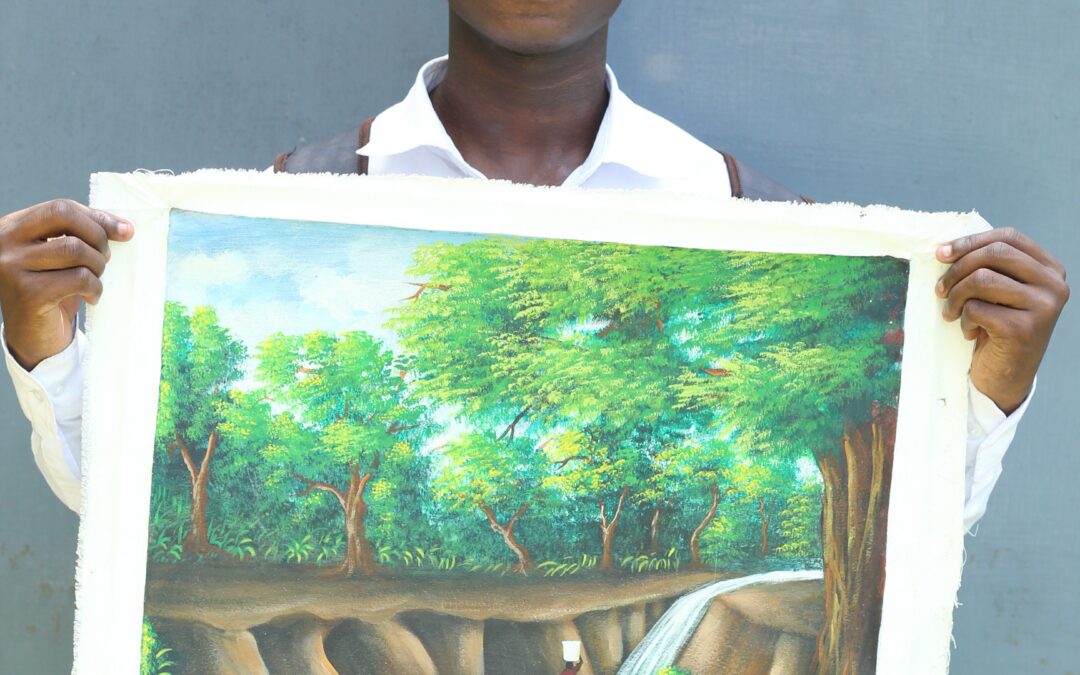
When people look at children’s artwork, they often see colorful houses, rivers, mountains, trees, and winding dirt paths. But when students at Teach Haiti paint, they are doing far more than creating pictures. They are telling stories about the world they know — and inviting the rest of the world to listen.
Those small homes painted across their canvases reflect a reality that millions of Haitian families live every day. In Haiti, it is common for multiple generations to share one small space: parents, grandparents, cousins, aunts, and uncles living together in homes far smaller than what many Americans would consider normal. While the average U.S. home exceeds 2,000 square feet, many Haitian families share spaces only a fraction of that size, often built from concrete blocks, tin roofs, or whatever materials are accessible.
The dirt paths and narrow roads students paint are not imagined landscapes. They are the roads children walk daily — to school, to church, to the market, and home again. Some roads in Haiti remain unpaved, difficult to navigate during rainstorms, and challenging for transportation. Yet to these children, those roads are simply part of life. They are familiar. They are home.
Haiti is often portrayed through the lens of poverty or hardship. Our students remind us there is also beauty, culture, resilience, and joy woven into everyday life.
Why Creative Education Is Essential — Not Optional
At Teach Haiti, we believe education should be about far more than memorization and test scores. Through our Complete Education Model, we are committed to developing the whole child: academically, spiritually, emotionally, creatively, and socially. Art is a vital part of that transformation.
For many children in Haiti, access to art supplies is extremely rare. Some students may never hold a crayon, paintbrush, or canvas during their entire elementary education — simply because schools lack the resources for creative programs. When institutions are struggling to provide books, meals, or basic supplies, art classes are often the first thing cut as “nonessential.”
But creativity is not nonessential.
Art gives children a voice before they fully know how to express themselves with words. It allows them to process emotions, build confidence, strengthen problem-solving skills, and imagine possibilities beyond their current circumstances. In communities where daily survival can overshadow everything else, art creates space for imagination to breathe.
Research consistently shows that access to arts education improves academic outcomes, emotional regulation, and long-term social development — benefits that extend far beyond the classroom.
When a Child Paints Their Village, They’re Saying: “My Story Matters”
There is something profound that happens when a child picks up a paintbrush and renders the view from their front door onto a canvas. They are not just developing fine motor skills or learning about color theory. They are asserting their own dignity. They are saying: I exist. My home is real. My world has beauty.
That act of creation — however small — is transformative. It is the beginning of confidence. It is the seed of leadership.
This is precisely what makes the Complete Education Model different from traditional approaches. Teach Haiti is not only focused on helping children pass national exams. The mission is to restore dignity, build confidence, develop leadership, nurture faith, and empower the next generation of Haiti through a genuinely holistic education.
A Holistic Model for a Complete Future
Haiti’s children deserve an education that sees them fully — not just as students who need to pass a test, but as whole human beings with stories, gifts, creativity, and potential. That requires investing in every dimension of a child’s development, including the parts that can’t be measured on a standardized exam.
Education is not complete if a child never gets the opportunity to create. It is not complete if a child graduates knowing facts but not knowing their own worth. And it is not complete if the beauty and resilience embedded in Haitian culture is never reflected back to children in the classroom.
Sometimes, a simple paintbrush becomes part of changing a child’s future.
At Teach Haiti, that is the work — one child, one story, one brushstroke at a time.
Sponsor a student’s tuition this upcoming school year, so they can receive an education at Teach Haiti and receive a Complete Education. SPONSOR A STUDENT