
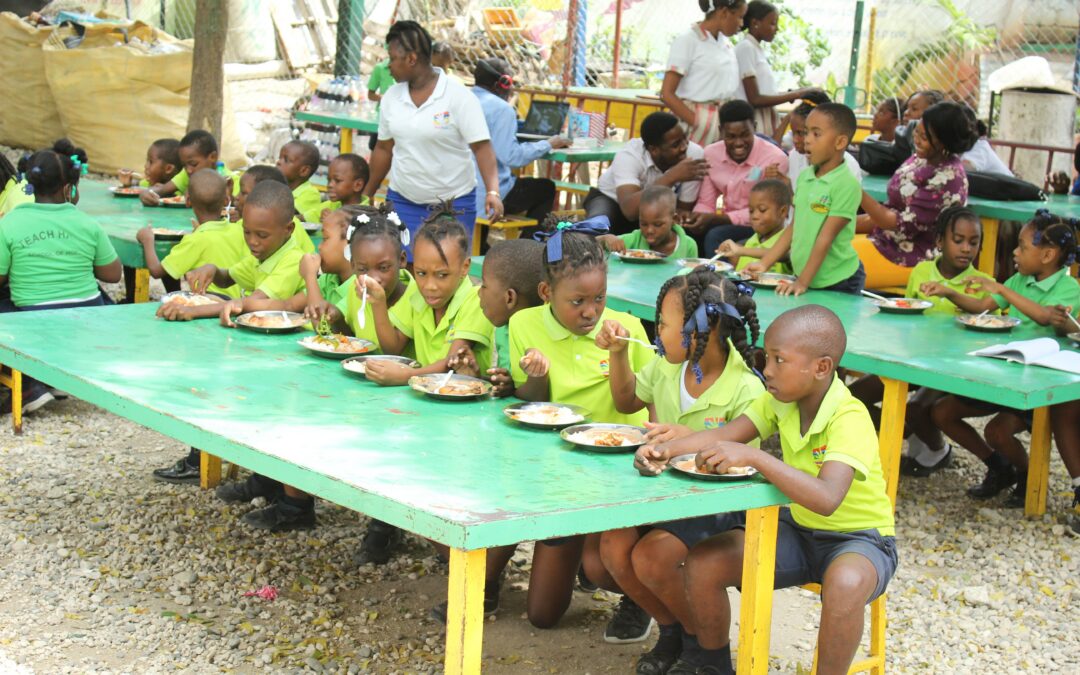
Walk into Teach Haiti this fall and you’ll notice freshly painted walls and chairs that don’t wobble anymore. What you won’t see, unless you know to look for it, is the story behind them: a summer where students, parents, and teachers kept the school running together, long after the last bell of the school year rang.
This is what Teach Haiti looks like outside the regular school calendar. We’re a year-round anchor for the families and neighborhoods we serve — a place that opens its doors not just for lessons, but for meals, second chances, summer learning, and community care.
Who We Serve
Our sponsorship program exists first and foremost for students from low-income families — children whose families could never afford tuition at other schools. To join, students take an entrance exam. If they pass, they’re in. If they don’t, we don’t turn them away immediately — we give them a second chance. Many of our students are growing up in neighborhoods where daily life includes real instability and exposure to violence, and we don’t think a single test on a single day should be the only measure of what a child can do. Only if a student is still unable to pass after two attempts are they unable to enroll.
We also try to match students’ ages to the appropriate grade level. But we know life doesn’t always follow a straight line, so when circumstances call for it, we make exceptions rather than shutting a student out over a technicality.
It’s worth noting: not every student at Teach Haiti is on our sponsorship list. Fewer than 5% of our student body comes from more affluent families who can pay their own way. These families choose us anyway, because they trust and believe in the Teach Haiti education model. Their presence doesn’t change our mission — it helps sustain it, and it means our classrooms bring together kids from different economic backgrounds learning side by side. It’s a quiet vote of confidence in the school we’ve built.
Summer Wasn’t a Break From the Mission
For many schools, summer means empty hallways. At Teach Haiti, this past summer meant the community showed up.
Students who live in the neighborhood — and many of our students do — came back to the school during their break simply to be there. They played in the yard, helped teachers with small tasks, and even helped cook meals. Students who pitched in in the kitchen got a hot meal for their effort, and any leftover food didn’t go to waste — it was packaged up and sent home with families as extra support for the summer months, when resources are often stretched thinnest.
Learning didn’t stop either. We sent students home with a free package of books to keep them reading and practicing over the break. Students who struggle academically were invited back for extra sessions to keep building their skills rather than losing ground. And for children who showed up hungry, whether or not they were formally enrolled in our sponsorship program, we made sure they got fed — and connected struggling families with financial assistance when we could.
A Community That Builds Together
Parents were part of this rhythm too. Over the summer, many came to the school to help clean and prepare food, turning maintenance into another form of community gathering.
Then, as the new school year approached in August and September, students themselves got involved — fixing chairs, painting classrooms and hallways, getting the building ready to welcome everyone back. There’s something powerful in a child sanding down a chair or painting a wall they’d soon sit and learn beside. This isn’t just a school they attend; it’s a school they helped build, literally, with their own hands — and it’s the same building they’re sitting in right now.
Why It Matters
None of this was required. There’s no rule that says a school has to feed hungry kids in July, send books home for summer reading, or give a struggling test-taker a second chance. But at Teach Haiti, we believe education can’t be separated from the everyday realities our students face — hunger, instability, and neighborhoods where opportunity isn’t always easy to come by.
By keeping our doors open all year, in ways big and small, we’re not just teaching children. We’re standing alongside the families and communities that make our school what it is — and now that the new year is underway, that same community is what fills these freshly painted classrooms every morning.
If that’s a model of education you believe in too, there are a few ways to be part of it — sponsor a student, donate toward our summer food and book programs, or volunteer your time during the school year. Every bit of support helps us keep our doors, and our kitchen, open.