
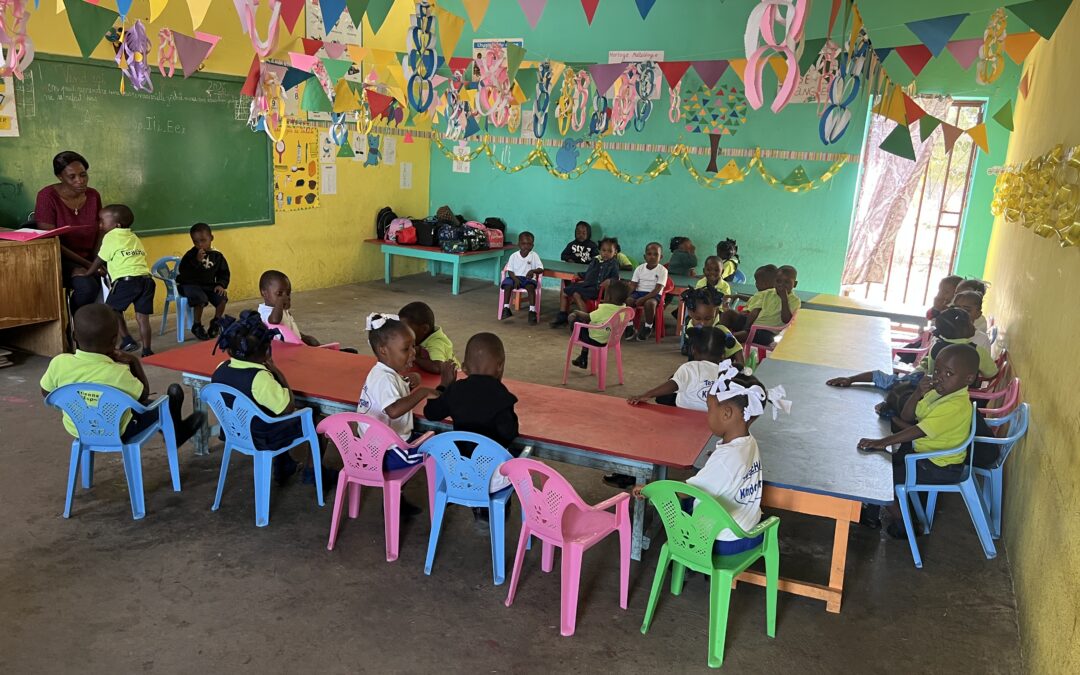
Walk into a classroom in the United States this time of year, and you’ll likely see the same things: store-bought birthday charts, laminated alphabet posters, colorful number lines ordered online and pulled straight out of the package. It’s a familiar back-to-school ritual. In Haiti, teachers are doing the very same thing this month, decorating their classrooms and preparing new learning charts for the year ahead, but the process looks nothing alike.
WHEN THE MATERIALS DON’T EXIST, TEACHERS MAKE THEM
In Haiti, pre-made classroom materials in Haitian Creole are extremely difficult to find. There’s no store shelf stocked with Creole alphabet posters or Creole number charts to choose from. So instead of ordering supplies, Teach Haiti’s teachers make them, by hand, from scratch, chart by chart, letter by letter. Every birthday chart, every learning poster, every piece of classroom decor is designed and created by the teacher who will use it all year long.
MORE THAN DECORATION
This isn’t just about making a classroom look nice. These handmade charts are often literally the only Creole-language learning materials students will see all year. A hand-lettered alphabet poster isn’t a decoration, it’s a teaching tool a teacher couldn’t purchase anywhere, so they built it themselves with paper, markers, and hours of their own time.
WHAT SETS TEACH HAITI APART
Most schools in Haiti don’t have the painted walls, murals, or built-in decor that many classrooms elsewhere start with. Many classrooms are simply plain cement, with no paint and no color to begin with. This is where Teach Haiti’s difference shows up most clearly: our teachers don’t just accept those bare walls, they transform them. With nothing but paper, glue, and creativity, a Teach Haiti classroom becomes a bright, welcoming learning space built entirely by the hands of the teacher who leads it. That commitment, going beyond the walls a school gives you and building something better for your students, is what makes a Teach Haiti classroom different from the moment a student walks in.
A LABOR OF LOVE WORTH CELEBRATING
This September, as classrooms across Haiti fill with color again, it’s worth pausing to recognize the hours of unseen work behind every chart on every wall. It’s a quiet kind of dedication: no supply budget, no laminator, no pre-made kits, just teachers who care enough to build their students’ learning environment with their own two hands.
Teach Haiti is proud to support the teachers doing this work every year. If you’d like to make a one-time donation towards school supplies for the 2026-2027 school year visit www.teachhaiti.org/donate.
x
Meta description: As the new school year begins, Teach Haiti’s teachers are hand-decorating their classrooms, and hand-making every learning chart, since pre-made materials in Haitian Creole simply aren’t available.
Walk into a classroom in the United States this time of year, and you’ll likely see the same things: store-bought birthday charts, laminated alphabet posters, colorful number lines ordered online and pulled straight out of the package. It’s a familiar back-to-school ritual. In Haiti, teachers are doing the very same thing this month, decorating their classrooms and preparing new learning charts for the year ahead, but the process looks nothing alike.
WHEN THE MATERIALS DON’T EXIST, TEACHERS MAKE THEM
In Haiti, pre-made classroom materials in Haitian Creole are extremely difficult to find. There’s no store shelf stocked with Creole alphabet posters or Creole number charts to choose from. So instead of ordering supplies, Teach Haiti’s teachers make them, by hand, from scratch, chart by chart, letter by letter. Every birthday chart, every learning poster, every piece of classroom decor is designed and created by the teacher who will use it all year long.
MORE THAN DECORATION
This isn’t just about making a classroom look nice. These handmade charts are often literally the only Creole-language learning materials students will see all year. A hand-lettered alphabet poster isn’t a decoration, it’s a teaching tool a teacher couldn’t purchase anywhere, so they built it themselves with paper, markers, and hours of their own time.
WHAT SETS TEACH HAITI APART
Most schools in Haiti don’t have the painted walls, murals, or built-in decor that many classrooms elsewhere start with. Many classrooms are simply plain cement, with no paint and no color to begin with. This is where Teach Haiti’s difference shows up most clearly: our teachers don’t just accept those bare walls, they transform them. With nothing but paper, glue, and creativity, a Teach Haiti classroom becomes a bright, welcoming learning space built entirely by the hands of the teacher who leads it. That commitment, going beyond the walls a school gives you and building something better for your students, is what makes a Teach Haiti classroom different from the moment a student walks in.
A LABOR OF LOVE WORTH CELEBRATING
This September, as classrooms across Haiti fill with color again, it’s worth pausing to recognize the hours of unseen work behind every chart on every wall. It’s a quiet kind of dedication: no supply budget, no laminator, no pre-made kits, just teachers who care enough to build their students’ learning environment with their own two hands.
Teach Haiti is proud to support the teachers doing this work every year. If you’d like to make a one-time donation towards school supplies for the 2026-2027 school year visit www.teachhaiti.org/donate.